Seedless table grapes in 500 g retail punnets, 10 per carton, 12,000 kg per 40ft reefer. May to October, from farms around Ismailia.
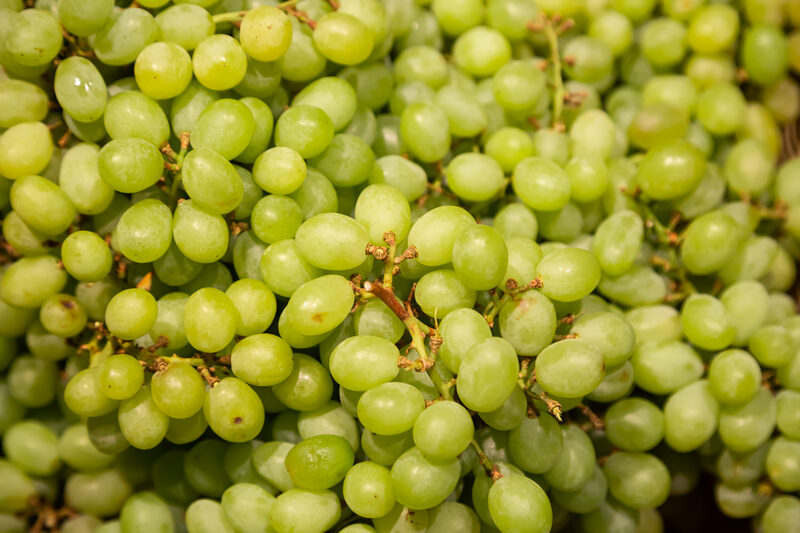
Grapes carry the summer, from May through October, in the months when the citrus is finished and before the mango is fully in. For a buyer running a year-round programme out of Egypt that is exactly where they are useful.
They go out seedless and punnet-packed for retail. The pack is what the shopper sees, so the specification conversation on grapes is usually about presentation as much as about the fruit.
The dusty grey film on a fresh grape is called bloom. It is produced by the grape itself, it is a natural wax, and it rubs off permanently the moment a bunch is handled roughly. That makes it far more useful than it looks: bloom that is still intact when a punnet reaches a shelf is evidence of a chain that did not manhandle the fruit anywhere along it.
Buyers sometimes read bloom as dust and ask for it to be cleaned off. It should not be. Wiped grapes look glossy for a day and then look tired, and you have removed the fruit's own protection against moisture loss.
The way a grape shipment fails is shatter — loose berries lying at the bottom of the punnet, off the stem. A punnet with shatter in it does not sell, even when every berry in it is perfectly good.
It comes from mechanical shock and from moisture loss at the stem, which means it is set by handling and by cold chain discipline rather than by the vineyard. Grapes are also sensitive to temperature swings in a way that is easy to underestimate on a long route; the reasoning is in our cold chain guide. Farms supplying the line are audited to GLOBALG.A.P..
Packed to order. Counts, cartons and grade all move against your spec — tell us what you need.
| Varieties | Early Sweet, Prime, Flame Seedless, Superior, Crimson and Autumn Royal across the season. |
|---|---|
| Product form | Seedless table grapes, bunches trimmed and packed retail-ready. |
| Grade | Class I standard. Brix and berry size to your specification. |
| Packing | 500 g punnet · 10 punnets per 5 kg carton. |
| Pallet configuration | Palletised to carton size; confirmed with your order. |
| 40ft container load | 2,400 cartons · 12,000 kg net |
| Shipping temperature | 0–1°C with SO₂ pads, unbroken cold chain from packhouse to port. |
| Season | May to October. |
| Certification | BRCGS, ISO 9001:2015, GLOBALG.A.P., registered with the U.S. FDA. Halal and Kosher available. Phytosanitary, health and origin certificates with every shipment. |
| Terms & ports | FOB, CIF and C&F. Loading Damietta, Alexandria, Port Said or Ain Sokhna. |
Tell us the punnet format, your volume, destination port and Incoterm — we send the spec sheet, certificates and a quote, usually within 24–48 hours.
Practical background from our side of the trade — free, no sign-up.
Fresh produce cannot be improved after harvest. Everything from the moment of picking is a slower or faster decline — and the single biggest…
Grading is not quality snobbery. It is the language two strangers use to agree, in advance, on what will be inside a container that neither of them…
The produce is rarely the hard part. What decides whether a first shipment becomes a programme is the specification, the paperwork and the payment…
See the full citrus range, or all fresh produce.