Late-season Valencia in counts 40 to 125, packed in 15 kg and 8 kg cartons or 600 kg bins for juice factories. January to May, from farms around Ismailia.
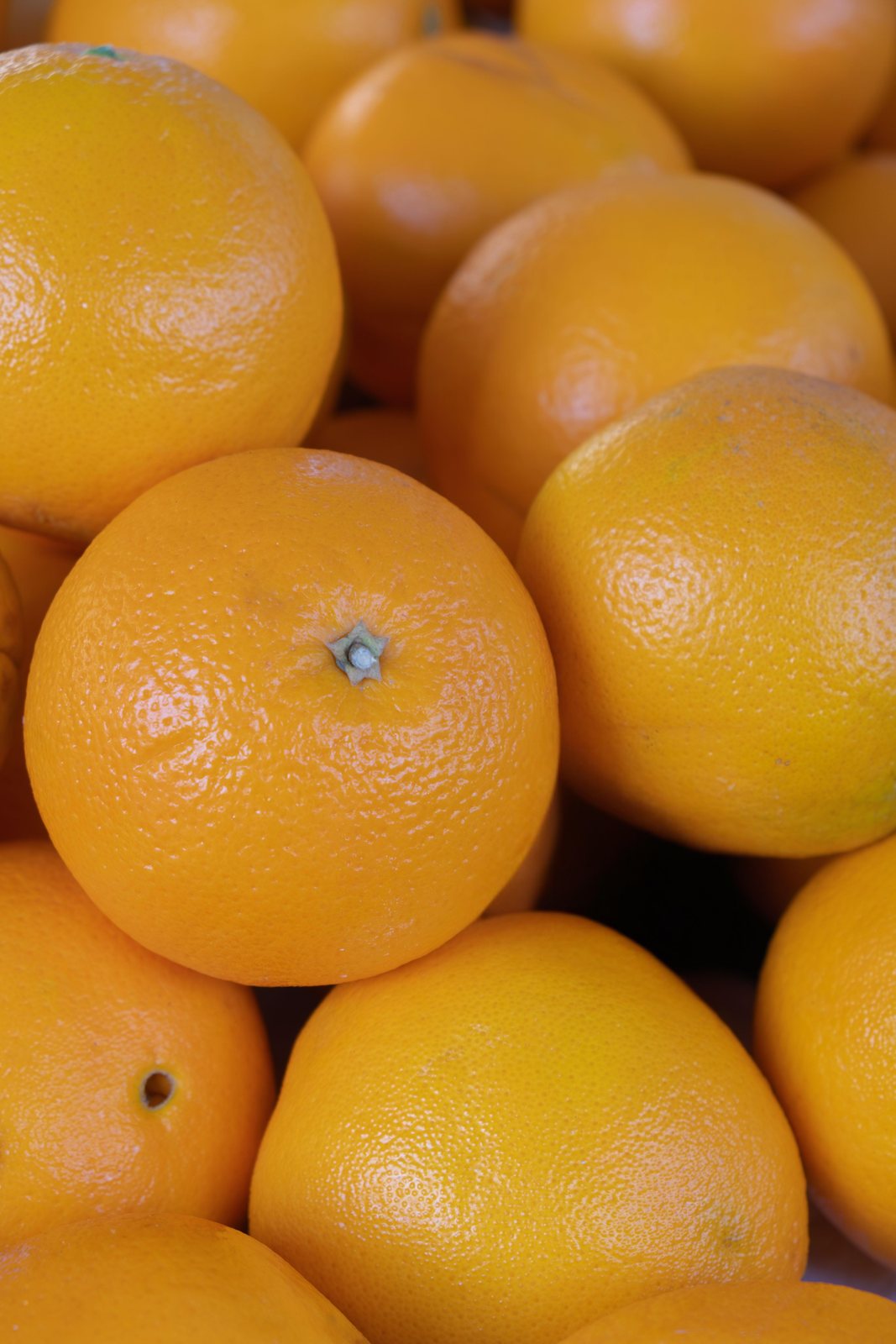
Valencia is the juicing orange. It arrives late, after Navel and Baladi have finished, and it is grown for juice yield rather than for how it looks in a hand — thin skin, high liquid content, a flavour that holds up once extracted. Buyers who want a table orange should be looking at Navel; buyers running a juice line almost always end up here.
It is also the reason our citrus season runs as long as it does. Valencia carries January to May on its own once the early varieties are gone, which is what turns a three-month citrus window into a five-month one.
The count is the number of fruit that fill a standard carton, so it runs backwards from what people expect. A count of 40 means forty large oranges fill a 15 kg carton. A count of 125 means one hundred and twenty-five much smaller ones fill the same box. Higher number, smaller fruit. It catches out nearly every buyer once.
Write the count into your specification rather than a word like large. Classes, calibres and tolerances all follow the UNECE standard FFV-14 for citrus fruit, which is worth naming in a contract for the same reason: it means both sides are arguing from one document if a container is ever disputed.
Cartons exist to protect fruit that will be looked at. A juice factory is not going to look at it — the fruit goes straight into an extractor — so paying for cartons, and for the container space cartons waste, is money spent on nothing.
That is what the 600 kg bins are for. If your Valencia is going to a processor, ask for bins and compare the landed cost per tonne rather than per carton; the gap is usually larger than people expect. If it is going to retail, take the cartons. Both are available from the same intake.
Packed to order. Counts, cartons and grade all move against your spec — tell us what you need.
| Variety | Valencia Late. Grown mainly for juice extraction. |
|---|---|
| Sizes / counts | 40 · 48 · 56 · 64 · 72 · 80 · 88 · 100 · 113 · 125 |
| Grade | Class I standard. Class II and industrial grades on request. |
| Packing | 15 kg telescopic carton · 15 kg open-top carton · 8 kg open-top carton · 15 kg plastic box · 600 kg bins for juice processors |
| Pallet configuration | 30×40×27 cm boxes · 10 per base × 8 high = 80 boxes per pallet · 20 pallets per 40ft |
| 40ft container load | 1,600 cartons · 24,000 kg net (15 kg carton, 16 kg gross) |
| Shipping temperature | 4–8°C, unbroken cold chain from packhouse to port. |
| Season | January to May. |
| Certification | BRCGS, ISO 9001:2015, GLOBALG.A.P., registered with the U.S. FDA. Halal and Kosher available. Phytosanitary, health and origin certificates with every shipment. |
| Terms & ports | FOB, CIF and C&F. Loading Damietta, Alexandria, Port Said or Ain Sokhna. |
Tell us the count, cartons or bins, your volume, destination port and Incoterm — we send the spec sheet, certificates and a quote, usually within 24–48 hours.
Practical background from our side of the trade — free, no sign-up.
Grading is not quality snobbery. It is the language two strangers use to agree, in advance, on what will be inside a container that neither of them…
Fresh produce cannot be improved after harvest. Everything from the moment of picking is a slower or faster decline — and the single biggest…
The produce is rarely the hard part. What decides whether a first shipment becomes a programme is the specification, the paperwork and the payment…
See the full citrus range, or all fresh produce.