Seedless Navel oranges in counts 24 to 100, 15 kg and 8 kg cartons, 24,000 kg per 40ft reefer. December to February, from farms around Ismailia.
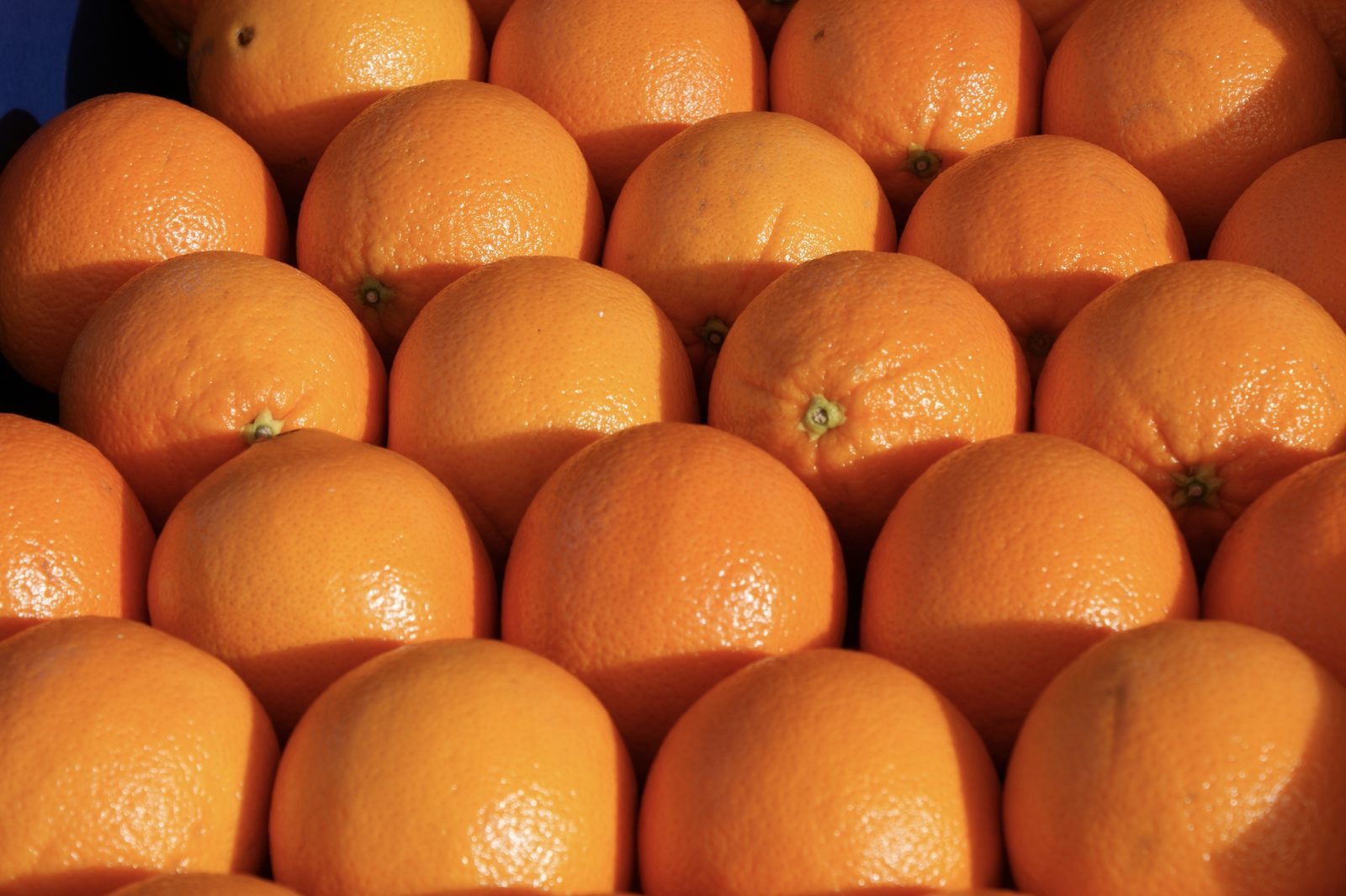
Navel is the orange people picture when they say orange: large, deep in colour, seedless, and easy enough to peel that a child can do it. It is a table fruit and a retail fruit, and if you are filling a shelf rather than a tank this is the one.
It carries the early part of the season alongside Baladi, from December through February, which is also when European demand for citrus is at its highest.
This is worth knowing before you buy, because it surprises people. Navel oranges contain limonin, and when the fruit is juiced the compound converts into a bitter form over a matter of hours. Freshly squeezed Navel juice is fine. Navel juice that has sat, or been processed and stored, develops a bitterness that no amount of blending fully hides.
It is not a defect and it is not a supplier problem — it is the variety. If your product is juice, buy Valencia. If your product is fruit, Navel is the better orange in almost every other respect. A supplier who sells you Navel for a juice line either does not know this or is hoping you do not.
Twenty-four is very large fruit; one hundred is small. The count is how many fill a standard carton, so the number runs opposite to the size. Retail programmes in Europe tend to sit in the middle of that range, but it varies by market and by pack format, and we will tell you what your destination usually takes if you have no fixed view.
Farms supplying the line are audited to GLOBALG.A.P., and residues are managed against the limits your destination enforces — for European consignments, the EU pesticide MRL database.
Packed to order. Counts, cartons and grade all move against your spec — tell us what you need.
| Variety | Washington Navel and Navelina. |
|---|---|
| Sizes / counts | 24 · 36 · 40 · 42 · 48 · 56 · 64 · 72 · 80 · 88 · 100 |
| Grade | Class I standard. Class II on request. |
| Packing | 15 kg telescopic carton · 15 kg open-top carton · 8 kg open-top carton · 15 kg plastic box |
| Pallet configuration | 30×40×27 cm boxes · 10 per base × 8 high = 80 boxes per pallet · 20 pallets per 40ft |
| 40ft container load | 1,600 cartons · 24,000 kg net (15 kg carton, 16 kg gross) |
| Shipping temperature | 4–8°C, unbroken cold chain from packhouse to port. |
| Season | December to February. |
| Certification | BRCGS, ISO 9001:2015, GLOBALG.A.P., registered with the U.S. FDA. Halal and Kosher available. Phytosanitary, health and origin certificates with every shipment. |
| Terms & ports | FOB, CIF and C&F. Loading Damietta, Alexandria, Port Said or Ain Sokhna. |
Tell us the count, your volume, destination port and Incoterm — we send the spec sheet, certificates and a quote, usually within 24–48 hours.
Practical background from our side of the trade — free, no sign-up.
Grading is not quality snobbery. It is the language two strangers use to agree, in advance, on what will be inside a container that neither of them…
Fresh produce cannot be improved after harvest. Everything from the moment of picking is a slower or faster decline — and the single biggest…
Suppliers send logo sheets. Buyers need to know which of those logos are a legal requirement, which are the price of entry to a retailer, and which…
See the full citrus range, or all fresh produce.