Red onions in three size bands from 40 to 100 mm, bagged at 10, 25 and 50 kg, 24,000 kg per container. April to July.
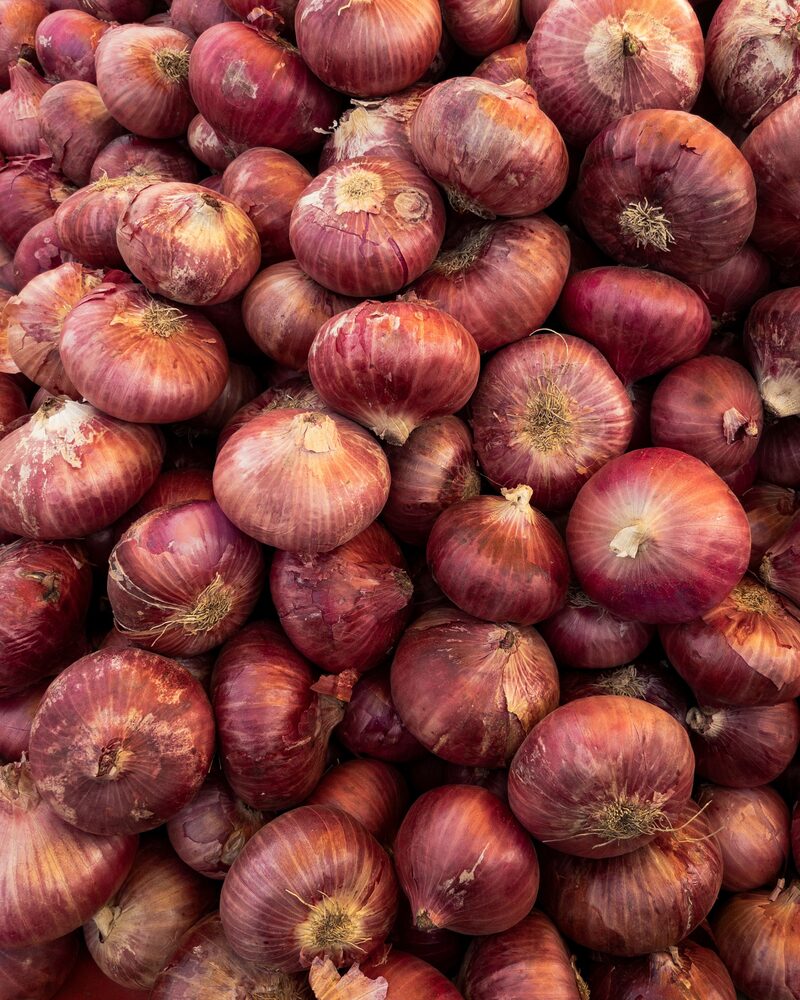
Onions are the one line here that is not a chilled product, and treating them like one is how a container is lost. They are a stored crop: lifted, cured, graded and then shipped dry and ventilated. Everything that decides whether they arrive in condition happens in the curing.
Egypt ships a great deal of onion and the reason is straightforward — the climate cures them well and the season lands where other origins have gaps.
Curing is drying the outer skins and, more importantly, the neck of the bulb after lifting. An onion with a green or damp neck is an onion with an open route into its centre, and in a warm container that becomes neck rot. It does not show on the outside until it is far too late, which is what makes it dangerous: a pallet can look immaculate and be failing inside.
Properly cured onions have papery, closed skins and dry necks, and they keep for months. It is unglamorous and it is the single most important thing about buying onions.
Onions travel dry and breathing. They give off moisture, and if that moisture cannot escape it condenses on the bags and starts the rot that curing was meant to prevent — which is why they go in ventilated containers rather than sealed refrigerated ones, at 24,000 kg per container.
It is worth stating plainly because buyers coming from chilled produce often assume a reefer is always the safer choice. On onions it is not; airflow matters more than temperature.
40−60 mm, 60−80 mm and 80−100 mm, bagged at 10, 25 or 50 kg depending on the channel. Retail takes the smaller bags and usually the middle band; wholesale and food service take the 25 and 50 kg bags across all three.
Say the band and the bag together when you send a specification, because the combination is what sets the price.
Packed to order. Counts, cartons and grade all move against your spec — tell us what you need.
| Product | Red onion, cured, dry-skinned. |
|---|---|
| Sizes | 40–60 mm · 60–80 mm · 80–100 mm |
| Grade | Class I standard. Firm, sound bulbs with dry outer skin. |
| Packing | 10 kg · 25 kg · 50 kg mesh bags. |
| Pallet configuration | 25 kg bags: 48 per pallet · 50 kg bags: 24 per pallet · 20 pallets per 40ft |
| 40ft container load | 25 kg: 960 bags · 50 kg: 480 bags — 24,000 kg net either way |
| Shipping temperature | 0–2°C with low humidity and good ventilation, or ventilated dry container on shorter routes. |
| Season | April to July. |
| Certification | BRCGS, ISO 9001:2015, GLOBALG.A.P., registered with the U.S. FDA. Halal and Kosher available. Phytosanitary, health and origin certificates with every shipment. |
| Terms & ports | FOB, CIF and C&F. Loading Damietta, Alexandria, Port Said or Ain Sokhna. |
Tell us the size band, bag format, volume, destination port and Incoterm — we send the spec sheet, certificates and a quote, usually within 24–48 hours.
Practical background from our side of the trade — free, no sign-up.
The produce is rarely the hard part. What decides whether a first shipment becomes a programme is the specification, the paperwork and the payment…
Grading is not quality snobbery. It is the language two strangers use to agree, in advance, on what will be inside a container that neither of them…
Suppliers send logo sheets. Buyers need to know which of those logos are a legal requirement, which are the price of entry to a retailer, and which…
See the full citrus range, or all fresh produce.