Zebda, Keitt, Naomi and Owais, grown around Ismailia and cut to three cube dimensions or sliced. Grade A, packed from 400 g retail bags to the 10 kg bulk cartons most buyers take.
Four varieties rather than one, on purpose. Each peaks at a different point in the season, which stretches the window and gives a wider range of fruit than a single-variety line can. The growers are farms around Ismailia we have worked with for more than fifteen years, and every variety goes in at peak ripeness rather than at whatever date suits the schedule.
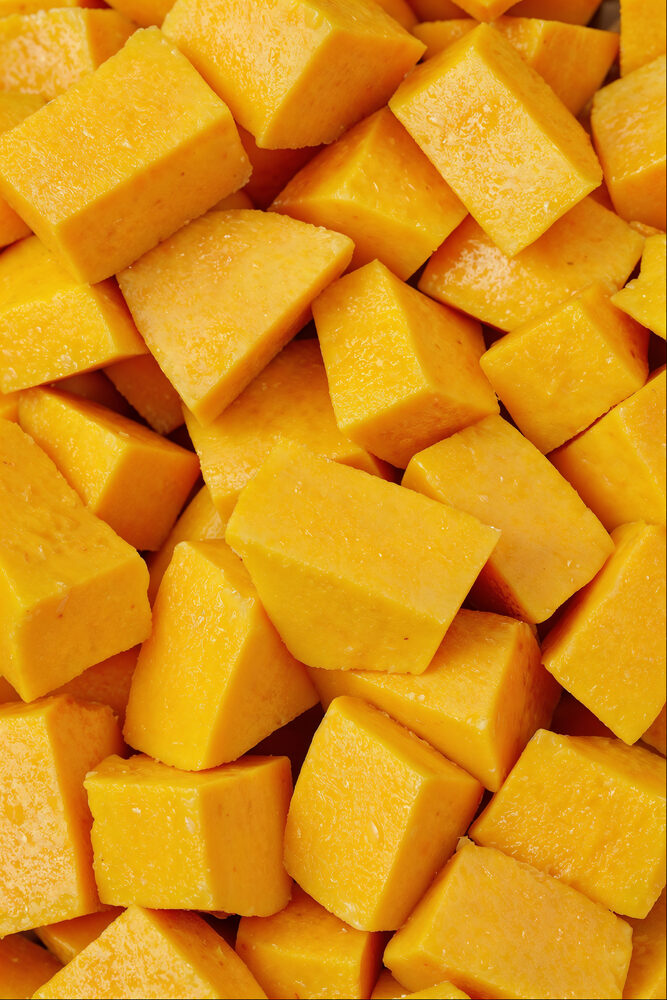
Cubes come at 10×10 mm, 10×15 mm and 20×20 mm. Slices are the other standard form and the one that moves in volume. Which you want depends entirely on what happens next: the small cube goes into yoghurt and bakery work where the fruit has to disappear into the product, the 20 mm cube holds up in a smoothie or a compote where you want to find it, and slices are what most food service and processing buyers order.
Some of the cutting is done by machine and some by hand. The hand work is not nostalgia — ripe mango is soft, and a machine that is fine on firm fruit will tear the larger cuts. Doing those by hand is slower, and it is why the shape survives freezing.
The single most important thing we look at on the mango line is internal colour. Skin colour is a poor guide in mango — it shifts with variety and with how the fruit was grown, and a green-skinned mango can be perfectly ripe. Codex CXS 184, the standard for mangoes, says as much in its own language: colour may change during ripening according to the variety, and maturity is judged on whether the fruit is sufficiently developed rather than on how it looks from outside.
So the fruit is cut and judged on the flesh. It is a slower way to sort than reading skin, and it is the reason a carton of our mango is the colour you expected when you open it.
Running four varieties buys a longer season, and it costs something. Zebda, Keitt, Naomi and Owais do not grow to the same size and they do not ripen to the same shade, so holding one cube dimension and something close to one colour across all four is the hardest thing we do on this line. It is a sorting and calibration problem, and it is worked at constantly rather than solved once.
We would rather say that than pretend it is easy. If colour consistency matters more to your product than season length does, tell us — a programme can be run from a narrower set of varieties, and that is a conversation worth having before the first container rather than after it.
Packed to order. Transit runs two to four days to the Gulf by truck, three to twenty-seven days into Europe depending on destination, and up to a month to the United States.
| Product forms | Slices · Cubes · Chunks · Halves on request |
|---|---|
| Grade | Grade A. Industrial grade for purée and juice on request. |
| Cut sizes | Cubes 10×10 mm, 10×15 mm and 20×20 mm. Slices and chunks to your drawing. |
| Varieties | Zebda, Keitt, Naomi and Owais. |
| Cutting | Machine and hand cut — larger cuts finished by hand to hold shape. |
| Retail & bulk packing | 400 g, 1 kg, 2.5 kg and 10 kg. The 10 kg bulk carton of slices is the format most buyers take. Private label available. |
| Freezing method | IQF at peak ripeness. Blast at −40°C to a fruit core of −18°C; lines run to European and American standards. |
| Storage | −18°C, unbroken cold chain from cold store to port. |
| Shelf life | 18 to 24 months from date of production. |
| Certification | BRCGS, ISO 9001:2015, GLOBALG.A.P., registered with the U.S. FDA. Halal and Kosher available. Third-party inspection accepted on request. |
| Supply | Year round. |
| Terms & ports | FOB, CIF and C&F. Loading Damietta, Alexandria, Port Said or Ain Sokhna. |
Tell us the cut, the format, your volume, destination port and Incoterm — we send the spec sheet, certificates and a quote, usually within 24–48 hours. Ask for the spec sheet and a price list together.
Practical background from our side of the trade — free, no sign-up.
How quick freezing works, why it beats block freezing, and the five things to check when a container lands.
Classes, counts and calibre bands — and how to write a specification a supplier cannot wriggle out of.
Incoterms, payment terms, the full document set and a realistic timeline from enquiry to arrival.
Fresh mango is a separate line — see fresh Zebda, Keitt and Naomi, or the whole IQF range.