Festival, Fortuna and Sensation, grown around Ismailia and through the freezing tunnel the same day they are picked. Grade A, calibre 10 mm and up, packed from 400 g retail bags to the 10 kg cartons most of our buyers take.
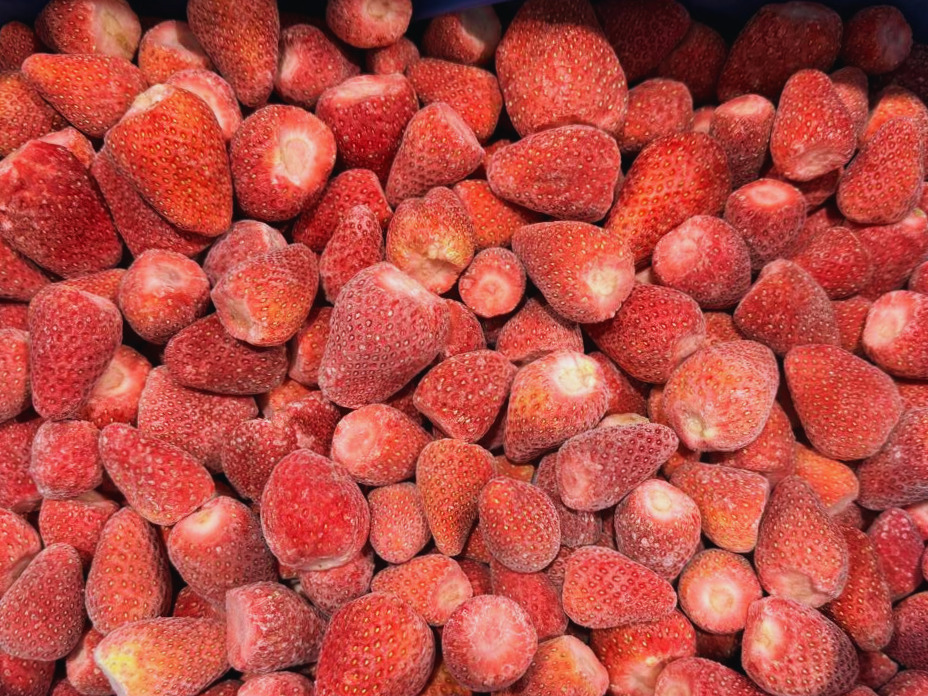
Strawberries punish delay more than any other fruit we handle. Fruit comes off the farms around Ismailia, is graded, and goes through the tunnel on the same day it was picked — not the next morning, not after a night in a holding room. Almost everything a buyer notices six months later is decided in those few hours.
More buyers ask for IQF than can say what it stands for, and it is worth thirty seconds because the difference is the whole product. Individually quick frozen means each berry is frozen on its own rather than as part of a block. The fruit goes into a blast at −40°C and stays there until the berry itself — not the air around it — reaches −18°C. From that point it is held and shipped at −18°C, unbroken, all the way to your door.
The result is fruit that pours out of the carton loose. Block-frozen strawberries arrive as one mass and have to be broken up or thawed whole, which costs you yield and control. IQF lets you take out four kilos and leave the rest frozen. Our lines run to European and American standards, and the styles we pack — whole, sliced, diced — are the ones set out in Codex standard CXS 52-1981 for quick frozen strawberries, which is a useful document to name in a specification because it also fixes the tolerances for disintegrated and blemished fruit.
The long version, including the five things to check when a container lands, is in our IQF guide.
Three varieties go into the frozen line, chosen because they hold colour and structure through freezing rather than because they look best fresh. They are grown by farms around Ismailia that we have worked with for more than fifteen years — long enough that the growing programme, the picking schedule and our tunnel capacity are planned as one thing rather than negotiated each season.
Fruit is frozen at the right moment and held in a 3,000-tonne cold store, which is what lets us supply the line all year round.
Everything below is packed to order. Where your line needs something different, say so and we will quote against it.
| Product forms | Whole · Sliced · Diced (cubes) |
|---|---|
| Grade | Grade A. Grade B and industrial grades available on request. |
| Calibre | 10 mm+ standard. 15−25 mm, 25−35 mm and 35 mm+ calibrated on request. |
| Varieties | Festival, Fortuna and Sensation — selected for colour retention and firmness after freezing. |
| Retail & bulk packing | 400 g, 1 kg, 2.5 kg and 10 kg. The 10 kg carton is the format most buyers take. Private label and custom cartons on request. |
| Freezing method | IQF. Blast at −40°C until the fruit core reaches −18°C; lines run to European and American standards. |
| Capacity | Up to 140 tonnes per day through the tunnels · 3,000 tonnes of cold store. |
| Storage | −18°C, unbroken cold chain from cold store to port. |
| Shelf life | 18 to 24 months from date of production. |
| Certification | BRCGS, ISO 22000, ISO 9001:2015, GLOBALG.A.P., registered with the U.S. FDA; factory registered with GACC (China Customs). Halal and Kosher available. Third-party inspection accepted on request. |
| Supply | Year round. |
| Terms & ports | FOB, CIF and C&F. Loading Damietta, Alexandria, Port Said or Ain Sokhna. |
Screening does not begin at the factory gate. Random samples are drawn from the farms and tested before harvest, against the residue limits our destination markets enforce — for European consignments that means the EU pesticide MRL database, which is also what our GLOBALG.A.P. certification is audited against. Testing a lot after it is frozen tells you what you already own; testing it in the field tells you what to pick.
Further checks run through production, and fruit that fails at any stage is pulled from that lot and moved to a lower grade or industrial use — it never goes back into the same carton. If you want your own inspector on site, or a third-party house you already use, we work with them — that request is common and it is never a problem.
A while back our cartons were made very slightly taller than they needed to be. Nothing was wrong with the fruit and nothing failed inspection — but the extra height meant fewer cartons fitted a container, and the freight cost per tonne went up for no reason at all. The buyer paid for air.
We changed the carton so it fits the container exactly. It is a small thing and an unglamorous one, but container utilisation is a real line in a landed cost, and it is the kind of detail that only turns up once you have shipped enough of something to notice it.
FOB, CIF and C&F, loading from four Egyptian ports. Transit runs two to four days to the Gulf by truck, three to twenty-seven days into Europe depending on destination, and up to a month to the United States.
Held and shipped in reefer containers at −18°C with the temperature logged from cold store to port.
Phytosanitary, health and origin certificates issued as production closes rather than after loading, with lot-level traceability on every pallet.
FOB, CIF and C&F from Damietta, Alexandria, Port Said or Ain Sokhna. Europe, the Gulf, Africa, Asia and the Americas.
Mixed containers across products are straightforward — everything below runs to the same specification discipline.
Zebda, Keitt, Naomi and Owais — slices, or cubes at three dimensions.
Three graded lengths: Extra, Zero and Excellent.
Peas, green beans, broccoli and cauliflower alongside the fruit lines.
Tell us the form, calibre, volume, destination port and Incoterm — we send the spec sheet, certificates and a quote, usually within 24–48 hours. Instead of a sample box, you get the full spec, a reference certificate of analysis and pre-loading inspection by the inspector you choose.
Practical background from our side of the trade — free, no sign-up.
How quick freezing works, why it beats block freezing, and the five things to check when a container lands.
Classes, counts and calibre bands — and how to write a specification a supplier cannot wriggle out of.
Incoterms, payment terms, the full document set and a realistic timeline from enquiry to arrival.
See all of our buyer's guides.